



Every growing business reaches a tipping point. You have successfully launched your product or service, revenue is climbing, and your team is expanding. Yet, behind the scenes, the financial complexity of your organization is multiplying at an alarming rate. Suddenly, your basic bookkeeping software and annual check-ins with a CPA are no longer sufficient to guide your strategic decisions. You find yourself asking complex questions about cash flow runways, capital allocation, debt restructuring, and long-term financial modeling—questions that require executive-level expertise. To know more, check out https://usfractionalcfo.com/
This is where the modern business landscape has introduced a game-changing solution: the fractional CFO.
In recent years, the concept of a part-time, highly experienced financial executive has revolutionized how small-to-medium businesses (SMBs) and startups manage their growth. Supported by elite professional networks like the US Fractional CFO Alliance, these seasoned financial veterans are democratizing access to top-tier financial strategy.
In this comprehensive guide, we will explore the intricate world of fractional financial leadership. We will dive deep into how these professionals operate, the immense value brought by specialized alliances, and how you can leverage their expertise to drive profitability and sustainable growth in your own organization.
The Fundamental Question: What Does a Fractional CFO Do?
To understand the value of this role, we must first clearly answer the question: what does a fractional cfo do?
At its core, a fractional Chief Financial Officer is an experienced finance executive who provides high-level strategic financial services to businesses on a part-time, retainer, or project basis. Unlike a full-time CFO, who commands a massive salary, equity, and benefits package, a fractional CFO splits their time among a handful of clients. This allows companies to tap into executive-level insight at a fraction of the cost.
However, the role goes far beyond simply balancing the books. A fractional CFO acts as a strategic partner to the CEO and leadership team. Their primary responsibilities typically include:
- Advanced Financial Modeling and Forecasting: Building dynamic models that project future revenue, expenses, and cash flow under various market scenarios.
- Capital Raising and Debt Strategy: Assisting startups and growing companies in preparing for funding rounds, negotiating with venture capitalists, or securing favorable terms with traditional lenders.
- Cash Flow Optimization: Implementing rigorous cash management strategies to ensure the business always has the liquidity needed to operate and grow, avoiding the “profitable but cash-poor” trap.
- Systems Implementation: Evaluating and upgrading internal financial software, ERP systems, and reporting tools to ensure data accuracy and operational efficiency.
- Mergers and Acquisitions (M&A) Support: Guiding businesses through the complex financial due diligence required when buying a competitor or selling the company.
The scope of fractional financial work is entirely scalable. Some businesses need a CFO for one day a week to sit in on executive meetings and review high-level dashboards. Others may need intensive, project-based work, such as a three-month engagement to prepare for a Series B funding round. This flexibility is what makes the fractional model so incredibly attractive to modern businesses.
Virtual CFO vs Accounting Firms: Understanding the Difference
A common point of confusion for many business owners is distinguishing between their current accounting setup and the need for a CFO. You might think, “I already have an accounting firm handling my taxes and payroll, do I really need a CFO?”
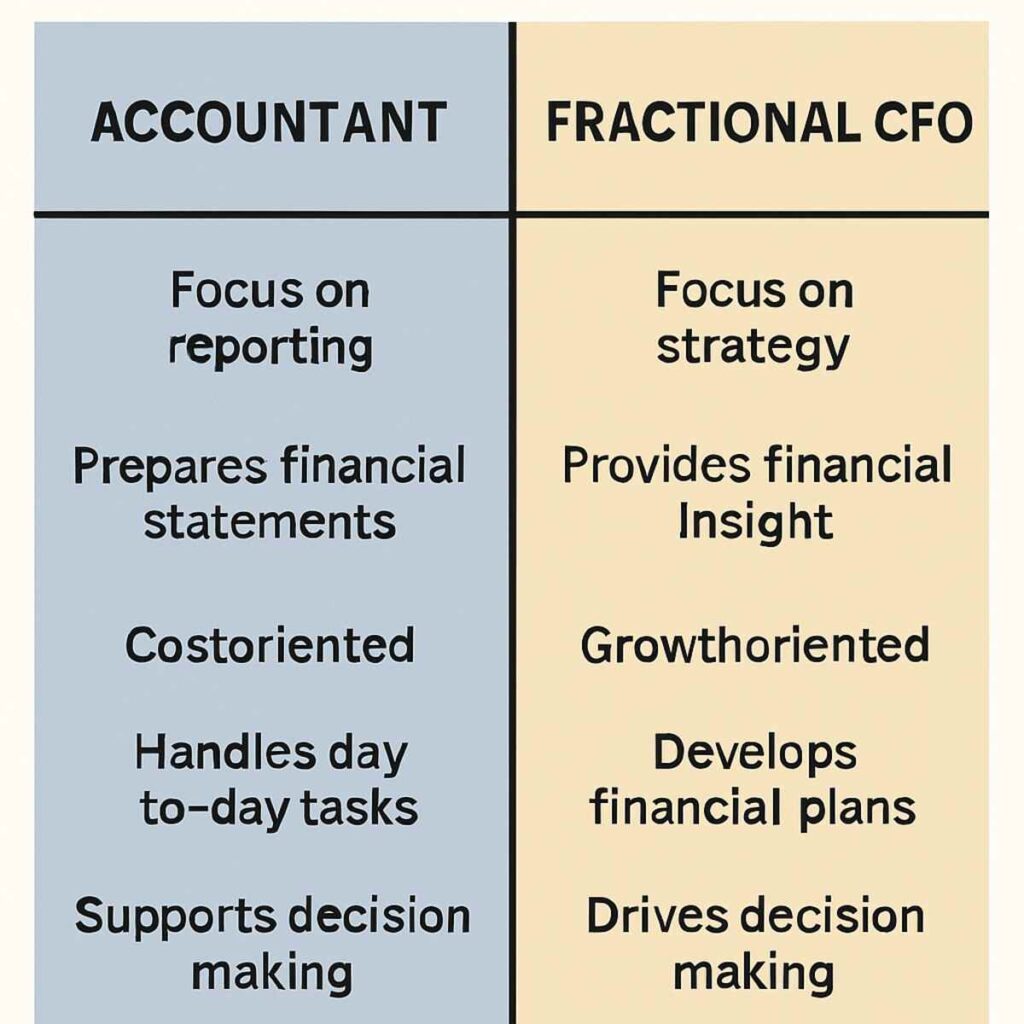
To maximize your business finance strategy, it is critical to understand the battle of virtual cfo vs accounting firms. While both deal with your company’s money, their perspectives, functions, and ultimate value propositions are fundamentally different.
The Backward-Looking Nature of Accounting
Accounting and bookkeeping firms are primarily historians. Their job is to accurately record what has already happened. They categorize expenses, reconcile bank statements, manage payroll, and ensure that your business is compliant with local, state, and federal tax laws. Their focus is on accuracy, compliance, and historical reporting.
The Forward-Looking Nature of a CFO
A fractional or virtual CFO, on the other hand, is a futurist. They take the accurate historical data provided by your accounting team and use it to predict and shape the future.
Here is a breakdown of the differences:
- Time Horizon: Accountants look backward (last month, last quarter, last year). CFOs look forward (next quarter, next year, the next five years).
- Primary Goal: Accountants focus on compliance, tax minimization, and accurate record-keeping. CFOs focus on growth strategy, risk mitigation, and enterprise value creation.
- Deliverables: Accountants deliver tax returns, P&L statements, and balance sheets. CFOs deliver dynamic cash flow forecasts, operational KPIs, funding strategies, and ROI analyses on new initiatives.
- Communication: An accountant tells you exactly how much money you made last year. A CFO tells you how much money you will likely make next year, and what strategic levers you need to pull today to increase that number.
In a mature financial ecosystem, these two roles do not compete; they collaborate. A skilled fractional CFO relies on the flawless data provided by your accounting firm to build their predictive models.
Financial Management for Scaling Businesses
When a business transitions from a scrappy startup to a scaling enterprise, the financial infrastructure must evolve. Financial management for scaling businesses is a complex undertaking that requires a steady hand and a strategic mind.
Rapid growth often masks underlying financial inefficiencies. When revenue is doubling year over year, it is easy to ignore creeping customer acquisition costs, bloated operational expenses, or inefficient inventory turnover. However, as growth eventually stabilizes, these inefficiencies can cripple profitability.
A fractional CFO steps into a scaling business to implement critical financial controls. They establish a rhythm of financial discipline, ensuring that growth does not outpace the company’s infrastructure.
Key Pillars of Scaling Finance
- Unit Economics: A fractional CFO will dissect your product or service lines to determine true unit profitability. They will factor in direct costs, allocated overhead, and customer acquisition costs to tell you exactly which parts of your business are driving profit and which are dragging you down.
- Working Capital Management: As sales increase, so do accounts receivable and inventory needs. If not managed correctly, a company can literally grow itself into bankruptcy by running out of cash before collecting on its sales. A CFO implements strict working capital strategies to prevent this.
- Scalable Tech Stacks: Manual data entry might work for a $1M company, but it will break a $10M company. Fractional CFOs lead the migration to robust ERPs and automated financial dashboards.
By providing these shared financial resources for startups and scaling SMBs, a fractional CFO ensures that the company is built on a foundation of solid financial reality, not just optimistic sales projections.
Enterprise Financial Strategy for SMBs
Historically, the most sophisticated financial strategies were reserved for Fortune 500 companies that could afford massive, dedicated finance departments. Today, the fractional model has democratized access to high-level financial intelligence.
Implementing an enterprise financial strategy for smbs means bringing big-business rigor to a smaller organization. This involves a shift from reactive decision-making (“Do we have enough cash to hire someone this month?”) to proactive, data-driven strategy (“Our financial model dictates that if we hire three salespeople now, our ROI will be positive in month seven, funded by our current credit facility”).
This approach involves cost effective strategic planning. Instead of guessing the outcome of a major business pivot, an SMB with a fractional CFO can run Monte Carlo simulations, sensitivity analyses, and scenario planning.
For example, if an SMB is considering expanding into a new geographic market, the fractional CFO will not just look at the cost of the new lease. They will model out the timeline to break-even, the impact on corporate tax liabilities, the required supply chain investments, and the potential cannibalization of existing sales. They provide the CEO with a comprehensive, enterprise-grade risk assessment before a single dollar is spent.
Niche Industry Financial Consulting: Why Specialization Matters
Not all businesses are created equal, and neither are all fractional CFOs. The intricacies of revenue recognition in a SaaS (Software as a Service) company are vastly different from the inventory costing methods in a manufacturing plant, which are different again from the billing complexities of a healthcare practice.
This is where niche industry financial consulting becomes incredibly valuable. When you hire a fractional CFO, you aren’t just looking for someone good at math; you are looking for someone who understands the specific financial heartbeat of your industry.
Examples of Industry-Specific CFO Expertise:
- SaaS and Technology: A specialized SaaS CFO will focus heavily on metrics like Monthly Recurring Revenue (MRR), Customer Acquisition Cost (CAC), Lifetime Value (LTV), and Churn rates. They understand the nuances of capitalized software development costs and deferred revenue.
- Manufacturing and Supply Chain: A CFO in this space will obsess over inventory turnover, supply chain financing, equipment depreciation schedules, and raw material cost variance analysis.
- Construction and Real Estate: Here, the focus shifts to project-based accounting, percentage-of-completion revenue recognition, surety bond compliance, and massive cash flow swings based on project milestones.
- E-commerce and Retail: These CFOs analyze return on ad spend (ROAS), warehouse logistics costs, multi-channel sales tax compliance, and seasonal cash flow forecasting.
Finding a fractional CFO with deep experience in your specific vertical ensures they can hit the ground running. They already know your industry’s benchmarks, they understand the common pitfalls, and they speak your language from day one.
The Rise of Outsourced Financial Leadership Networks
As the demand for fractional CFOs has exploded over the last decade, the industry has naturally evolved and matured. In the early days, hiring a fractional CFO meant finding a lone-wolf consultant on LinkedIn or through a local networking event. Quality was highly variable, and business owners had little assurance of the consultant’s actual capabilities.
Today, the landscape is defined by the rise of outsourced financial leadership networks and professional financial executive organizations. These alliances have standardized the fractional CFO industry, creating benchmarks for quality, ethics, and ongoing education.
These networks operate by gathering the best independent financial minds under one umbrella, providing them with shared resources, peer support, and a unified standard of practice. For a business owner, working with a CFO who belongs to a recognized network significantly reduces the risk of a bad hire.
The Role of The US Fractional CFO Alliance
At the forefront of this movement is the US Fractional CFO Alliance. This prestigious organization serves as a beacon of excellence in the fractional financial space. The US Fractional CFO Alliance is not an accounting firm or a simple staffing agency; it is a collaborative community of elite, vetted financial executives dedicated to elevating the standard of outsourced financial leadership.
When a business owner engages with a member of the US Fractional CFO Alliance, they are not just hiring an individual; they are gaining access to the collective intelligence of hundreds of top-tier financial professionals.
The alliance fosters an environment of continuous learning and peer review. If your fractional CFO encounters a highly obscure tax incentive scenario or an unprecedented M&A complication, they can instantly tap into the alliance’s network to consult with peers who have navigated that exact situation. This hive-mind approach provides SMBs with a level of problem-solving capacity that would be impossible to replicate internally.
Furthermore, the US Fractional CFO Alliance enforces strict standards for membership. They evaluate an applicant’s corporate background, track record of success, ethical standing, and strategic acumen before granting admission. This rigorous vetting process protects business owners, ensuring that the title of “Fractional CFO” actually carries weight and guaranteed expertise.
Executive Financial Membership Benefits
For the financial professionals themselves, joining organizations like the US Fractional CFO Alliance offers immense executive financial membership benefits. These benefits trickle down directly to the clients they serve.
- Continuous Professional Development: The financial landscape is constantly shifting—tax laws change, new funding mechanisms emerge, and economic headwinds alter market dynamics. Alliance members have access to exclusive workshops, seminars, and training that keep them at the absolute cutting edge of financial strategy.
- Proprietary Tools and Templates: Members often share access to highly sophisticated, battle-tested financial models, dashboard templates, and reporting software. This means a client’s CFO doesn’t have to reinvent the wheel, allowing them to deliver actionable insights much faster.
- Collaborative Financial Advisory Services: No CFO works in a vacuum. Alliance members frequently collaborate with other top-tier professionals, including fractional Chief Marketing Officers (CMOs), fractional Chief Operating Officers (COOs), specialized corporate attorneys, and HR experts. This ecosystem allows the CFO to facilitate holistic, collaborative financial advisory services that address every facet of a client’s business.
- Peer-to-Peer Mentorship: Even the most experienced executives encounter new challenges. The alliance provides a confidential sounding board where CFOs can seek advice on complex client issues, ensuring the client receives the most thoroughly vetted strategic advice possible.
A Comprehensive Hiring Guide for Fractional CFOs
Realizing that you need a fractional CFO is the first step. Actually finding and hiring the right one is another challenge entirely. Making the wrong choice can cost you time, money, and missed strategic opportunities.
To ensure a successful partnership, business owners should rely on a structured hiring guide for fractional cfos.
Phase 1: Internal Needs Assessment
Before looking outward, look inward. What are your immediate pain points?
- Are you running out of cash despite high sales?
- Are you preparing for a capital raise or a sale of the business?
- Do you simply lack visibility into your financial data? Defining the why will help you determine the specific skill set your ideal CFO needs.
Phase 2: Sourcing Candidates
Avoid relying solely on generic job boards. Instead, look toward reputable networks. Seeking out members of the US Fractional CFO Alliance or similar professional financial executive organizations immediately filters out unqualified candidates. You can also ask for referrals from your corporate attorney, your CPA, or other business owners in your industry.
Phase 3: Vetting Part-Time Financial Executives
When you begin interviewing, you must go beyond standard resume questions. Vetting part-time financial executives requires understanding their strategic mindset and their ability to communicate complex concepts.
Here are crucial questions to ask during the interview process:
- “Can you walk me through a time you helped a company in our industry navigate a cash flow crisis?” (Tests industry experience and crisis management).
- “How do you collaborate with existing accounting teams and CPAs?” (Tests emotional intelligence and understanding of role boundaries).
- “What KPIs would you prioritize for a business of our size and stage?” (Tests strategic alignment).
- “Can you explain a complex financial model to me as if I have no background in finance?” (Tests communication skills—your CFO must be a teacher, not just a number cruncher).
Phase 4: Defining the Scope of Work
Once you find the right candidate, clearly define the scope of fractional financial work. Will they work 10 hours a week or 40 hours a month? Will they attend weekly executive meetings? Are they responsible for presenting to the board of directors? Documenting these expectations in a clear Statement of Work (SOW) prevents scope creep and ensures alignment.
Phase 5: Onboarding and Integration
A fractional CFO cannot succeed if they are kept at arm’s length. Treat them as a true member of your executive team. Give them full access to your financial software, your accounting team, and your historical data. More importantly, give them insight into your strategic vision. The more transparent you are with your fractional CFO, the better they can guide you.
Improving Profitability with External Leadership
Ultimately, the goal of engaging a fractional CFO is not just to have better spreadsheets; it is to build a stronger, more resilient, and more profitable business. Improving profitability with external leadership is achieved through several direct interventions by the CFO.
1. Margin Expansion through Pricing Strategy
Many SMBs set their pricing based on competitor averages or “gut feeling” and rarely revisit it. A fractional CFO will conduct a deep-dive margin analysis. They often discover that due to creeping inflation and rising supply chain costs, the company’s margins have slowly eroded. By utilizing data-driven elasticity modeling, a CFO can recommend targeted price increases that drop straight to the bottom line without alienating the customer base.
2. Radical Cost Optimization
While you are busy focusing on top-line revenue, operational bloat often goes unnoticed. A fractional CFO brings an objective, emotionless eye to your P&L. They are skilled at identifying redundant software subscriptions, renegotiating vendor contracts, optimizing insurance premiums, and trimming inefficient marketing spend. Because they have seen the financials of dozens of other companies, they know exactly what your expenses should look like compared to industry benchmarks.
3. Accelerated Receivables and Delayed Payables
Cash is the lifeblood of profitability. A fractional CFO will overhaul your billing processes to ensure you get paid faster (e.g., implementing automated invoicing, enforcing late fees, shifting to upfront retainers). Simultaneously, they will strategically manage your accounts payable, ensuring you hold onto your cash for as long as legally and ethically possible without damaging vendor relationships. This optimization of the cash conversion cycle drastically reduces the need for expensive short-term debt.
4. Strategic Capital Allocation
Every dollar a business earns can be spent in multiple ways. Should you hire more sales reps? Should you invest in new R&D? Should you pay down debt? A fractional CFO uses ROI modeling to ensure that every dollar of profit is reinvested into the avenue that will generate the highest future return, compounding your profitability over time.
Navigating the Future of Business Finance
As the business world becomes increasingly complex, volatile, and globally interconnected, the days of relying on intuition and basic bookkeeping are over. Modern business finance requires agility, foresight, and a deep understanding of macroeconomic trends.
The fractional CFO model is uniquely positioned to meet this demand. It provides unparalleled flexibility, allowing businesses to dial up or dial down their financial leadership as their needs dictate. It bridges the gap between tactical accounting and visionary strategy.
Furthermore, the continued growth of alliances like the US Fractional CFO Alliance guarantees that this industry will only become more refined, capable, and essential in the years to come. By fostering collaboration, enforcing standards, and providing ongoing education, these networks are building the future of financial leadership.
Conclusion
Understanding the true value of a fractional CFO requires looking beyond traditional paradigms of employment. It requires recognizing that world-class financial strategy is no longer a luxury reserved for massive corporations, but a vital, accessible tool for ambitious startups and growing SMBs.
Whether you need help navigating a complex funding round, stabilizing a turbulent cash flow cycle, or simply mapping out a long-term strategy for profitable growth, a fractional CFO provides the exact expertise you need, right when you need it.
By leveraging outsourced financial leadership networks and adhering to a rigorous hiring process, you can find a financial partner who not only understands your numbers but deeply understands your vision. As you look to scale, optimize, and dominate your market, bringing a fractional CFO into your executive team might just be the most profitable investment you ever make.