



Football is more than just a global sport; it is a cultural phenomenon that unites billions of fans worldwide. Whether you are watching a tense Champions League final or a gritty local derby, the passion on the pitch is undeniable. For many fans, football betting adds an exhilarating layer to this experience. It transforms a passive viewing experience into an active, analytical pursuit where knowledge, strategy, and discipline can potentially lead to financial reward. Find out the best info about แทงบอล.
However, stepping into the world of sports wagering without a solid foundation is a recipe for disaster. The landscape is filled with complex terminology, fluctuating numbers, and psychological traps. To succeed, or at least to enjoy the process without unnecessary risk, you must approach it as a discipline.
This comprehensive guide is designed to take you from a curious observer to an informed participant. We will explore the mechanics of odds, dissect various betting markets, delve into advanced strategies, and lay down the golden rules of bankroll management. Whether your goal is to find long-term profitability or simply to enhance your weekend viewing, mastering the fundamentals is your first crucial step.
The Evolution of the Betting Landscape
Historically, placing a wager meant a trip to a physical bookmaker’s shop. You would write your selections on a slip of paper, hand over cash, and wait for the results. Today, the industry has undergone a massive digital revolution.
The proliferation of online betting sites has democratized access to global sports markets. Punters can now access hundreds of markets for a single match from the palm of their hand. These platforms offer not just convenience, but also a wealth of statistical data, live streaming options, and innovative betting features that were unimaginable two decades ago.
However, this accessibility is a double-edged sword. With thousands of matches available to bet on 24/7, the temptation to place impulsive wagers is higher than ever. Navigating this vast digital ecosystem requires a deep understanding of how the industry operates and, more importantly, how the bookmakers set their prices.
Decoding the Core Mechanics: Odds, Lines, and Margins
Before you place a single penny on a match, you must understand the language of the bookmaker. Odds are not just arbitrary numbers; they are an expression of probability and the bookmaker’s built-in profit margin.
Understanding Decimal and Fractional Odds
Odds represent two things: the implied probability of an event occurring, and your potential return if your bet is successful. Depending on where you are in the world, odds are displayed differently. Understanding decimal and fractional odds is a foundational skill.
- Fractional Odds: Traditionally used in the UK (e.g., 2/1, 5/2, 10/1). The first number (numerator) shows your potential profit, while the second number (denominator) shows your required stake.
- Example: A £10 bet at 5/2 means for every £2 you stake, you win £5. A winning bet returns £25 profit plus your £10 stake (Total return: £35).
- Decimal Odds: Most common in Europe, Australia, and increasingly worldwide. They represent the total return (profit + stake) for every 1 unit wagered.
- Example: Odds of 3.50. A £10 bet returns £35 total (£25 profit + £10 stake).
- Conversion: To convert fractional to decimal, divide the first number by the second and add 1. (e.g., 5/2 = 2.5 + 1 = 3.50).
While dealing with formats, it is also useful to briefly touch upon American odds, which revolve around a baseline of $100. A favorite might be -150 (meaning you must bet $150 to win $100), while an underdog might be +130 (meaning a $100 bet wins $130).
How to Read Betting Lines
When you open a sportsbook, you will be confronted with a vast grid of numbers. Learning how to read betting lines effectively is what separates novices from sharp bettors. The “line” refers to the current odds or handicap set by the bookmaker. These lines are dynamic; they shift based on team news, weather conditions, injuries, and, crucially, where the betting public is placing their money.
If a star striker is suddenly ruled out with an injury, the betting line will immediately shift to reflect the team’s decreased chances of winning. Watching how lines move throughout the week can provide valuable insights into market sentiment.
The Bookmaker’s Edge: Bookmaker Margin Calculations
Bookmakers are not charities; they are highly profitable businesses. They guarantee this profit by offering odds that do not entirely reflect the true mathematical probability of an event. This built-in edge is known as the overround, or the “vig” (vigorish).
Understanding bookmaker margin calculations is vital for assessing how fair a bookmaker’s odds are. Let’s look at a standard 1X2 (Home Win, Draw, Away Win) market:
- Home Win: 2.00 (Implied probability = 1/2.00 = 50%)
- Draw: 3.50 (Implied probability = 1/3.50 = 28.57%)
- Away Win: 4.00 (Implied probability = 1/4.00 = 25%)
If we add these probabilities together (50 + 28.57 + 25), the total is 103.57%. In a perfectly fair market, the total probability would be exactly 100%. That extra 3.57% is the bookmaker’s margin. The higher the margin, the poorer the value for the bettor. Sharp bettors actively seek out bookmakers with the lowest margins to maximize their long-term returns.
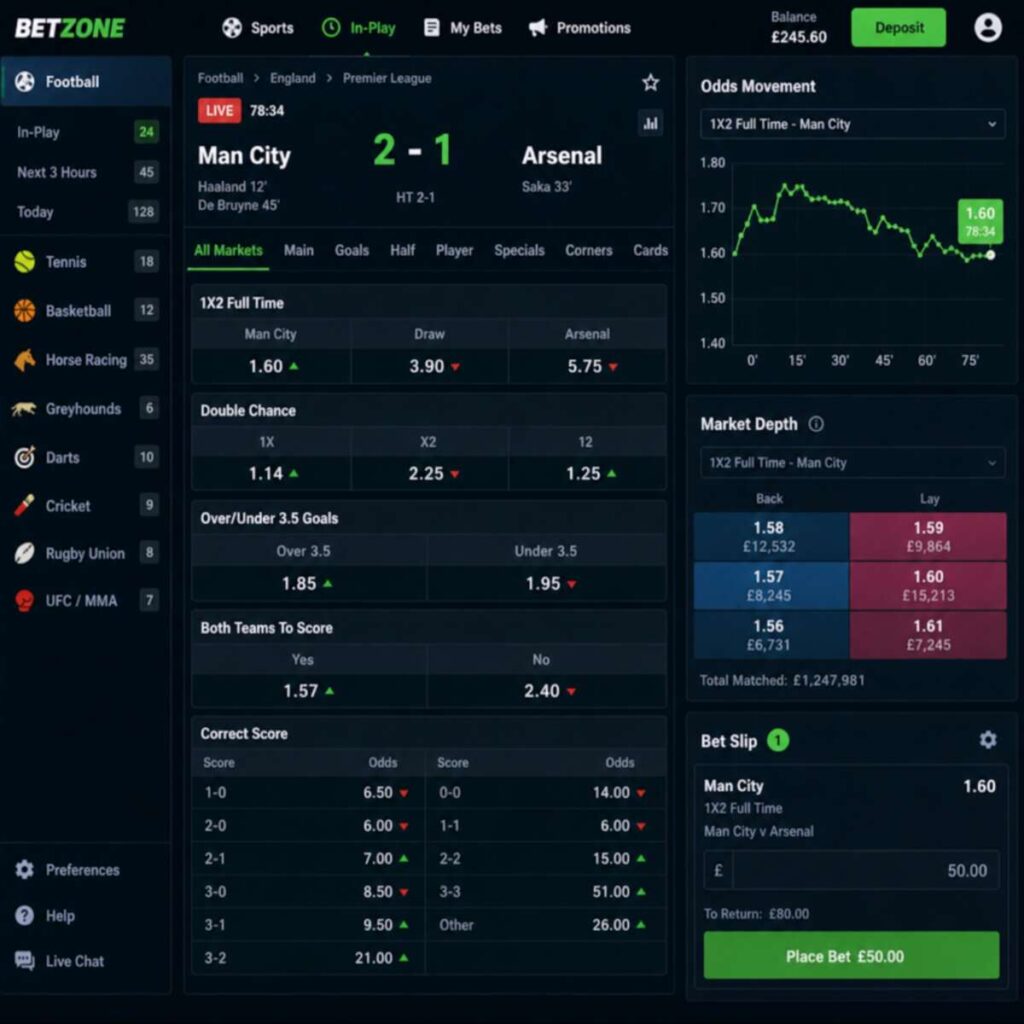
Primary Betting Markets: What Can You Bet On?
The modern sportsbook offers a staggering array of options. Let’s break down the most popular football betting markets.
The Match Result (1X2)
The most traditional and straightforward market. You are simply betting on the outcome of the match after 90 minutes (plus stoppage time).
- 1: Home team to win.
- X: The match to end in a draw.
- 2: Away team to win. Note: This market does not include extra time or penalty shootouts in knockout tournaments.
Goal Markets: A Beginner Guide to Over Under Goals
If predicting a winner feels too risky, goal markets offer an excellent alternative. The most popular is the Over/Under market. Here is a beginner guide to over under goals:
Instead of picking a team, you are wagering on the total number of goals scored by both teams combined. The bookmaker sets a “line,” usually ending in .5 to prevent a tie (a “push”).
- Over/Under 2.5 Goals: This is the industry standard for football. If you bet Over 2.5, you need 3 or more goals in the match (e.g., 2-1, 3-0, 2-2). If you bet Under 2.5, the match must have 2 or fewer goals (e.g., 0-0, 1-0, 1-1).
- Over/Under 1.5 or 3.5: Adjusting the line changes the risk and the odds. Betting Over 3.5 goals offers much higher odds because it requires a high-scoring game (at least 4 goals), whereas Over 1.5 offers lower odds as it only requires 2 goals.
Goal markets are fantastic because they keep you invested in the match until the final whistle, regardless of who is winning.
Leveling the Playing Field: Handicap Betting Explained
When a top-tier team (e.g., Manchester City) plays a lower-tier team (e.g., Sheffield United), the odds for the heavy favorite to win will be incredibly low, offering almost no value. To make the match appealing to bettors, bookmakers use handicaps.
Having handicap betting explained is a game-changer for many punters. It essentially applies a virtual deficit or advantage to a team before the game starts.
1. European Handicap (3-Way Handicap): This handicap operates in whole numbers and still allows for a draw outcome.
- Example: Manchester City (-1) vs. Sheffield United (+1).
- If you bet on City (-1), they must win by 2 or more goals to cover the handicap. If they win exactly 1-0, the “handicap draw” is the winning bet, and your bet on City loses.
2. Asian Handicap: Invented in Indonesia, the Asian Handicap eliminates the possibility of a draw, giving you essentially a 50/50 chance. It uses half and quarter goals.
- AH -0.5: The team must win the match. (Equivalent to a standard win bet).
- AH -1.5: The team must win by 2 or more goals.
- AH -0.25 (or 0.0, -0.5): This splits your stake. Half goes on a 0 handicap (Draw No Bet), and half goes on -0.5. If your team draws, you lose half your stake and get the other half refunded.
Moneyline vs Point Spread in Context
If you are transitioning from North American sports like American Football or Basketball, you might wonder about the moneyline vs point spread.
- Moneyline translates directly to the Match Result (1X2) or “Draw No Bet” markets in soccer. It is a straight bet on who will win outright.
- Point Spread translates to the Handicap markets we just discussed. Because scoring in soccer is so low compared to basketball, the “spread” is usually set at fractional goals (like -1.5) rather than large numbers like -7.5.
Advanced Betting Markets and Strategies
Once you have mastered singles and handicaps, you can explore more complex wagering avenues.
Multiples: What is an Accumulator Bet?
If you have ever heard someone talk about a “parlay” or an “acca,” they are referring to multiple bets combined into one. So, exactly what is an accumulator bet?
An accumulator allows you to combine four or more selections into a single wager. (Two selections are a Double, three are a Treble). To win the accumulator, every single selection in your bet must win. If even one leg fails, the entire bet loses.
The appeal of accumulators is the potential for life-changing payouts from tiny stakes, as the odds of each selection are multiplied together. For example, a £5 accumulator on five different teams to win, each at odds of 2.00, would pay out £160 (£5 x 2 x 2 x 2 x 2 x 2).Parlay Strategy Tips
While accumulators are fun, bookmakers love them because the bookmaker margin multiplies with every leg added. If you are going to play them, consider these parlay strategy tips:
- Keep it small: A 3-leg or 4-leg accumulator is much more likely to hit than a 15-leg lottery ticket.
- Avoid heavy favorites: Throwing in a team at 1.10 odds barely increases your payout but adds unnecessary risk. Shocks happen every weekend.
- Correlated Outcomes: Some bookmakers offer “Bet Builders” or Same Game Parlays. If you bet on a team to win 3-0, it makes sense to parlay that with their star striker to score, as the two events are positively correlated.
The Trading Floor: Fixed Odds vs Exchange Betting
The traditional betting model dictates that you wager against the bookmaker’s odds. However, there is an alternative ecosystem: betting exchanges. Understanding the difference between fixed odds vs exchange betting is vital for advanced punters.
- Fixed Odds (Traditional Sportsbook): You bet against the house. The bookmaker sets the odds and limits. They factor in their margin to ensure they profit over time.
- Betting Exchange (e.g., Betfair, Smarkets): The platform acts purely as a middleman, matching you with other bettors. You are betting against other people. The exchange takes a small commission (usually 2-5%) only on winning bets.
The primary advantage of an exchange is the ability to “Lay” a bet. In fixed odds, you can only “Back” an outcome to happen (e.g., Arsenal to win). On an exchange, you can “Lay” Arsenal, which means you are betting on them not to win (acting as the bookmaker). If the match ends in a draw or an Arsenal loss, your lay bet wins. Exchanges generally offer better odds than traditional sportsbooks because there is no built-in bookmaker overround, making them a crucial tool for serious bettors.
The Thrill of the Game: Live In-Play Wagering
Before the advent of high-speed internet, betting closed the moment the referee blew the starting whistle. Today, in-play (or live) betting represents a massive portion of all sports wagering.
There are significant live in-play wagering advantages for those who know how to read a game:
- Assessing Game Flow: Pre-match statistics cannot account for the mood of the players on the day. By watching the first 15 minutes, you can assess tactical setups, player motivation, and pitch conditions before placing your money.
- Finding Better Odds: If a heavy favorite concedes a shock early goal against the run of play, their odds to win the match will increase dramatically. If you believe they are still dominating and will turn it around, in-play betting allows you to back them at far better value than pre-match.
- Hedging and Trading: If you backed a team pre-match and they take a 1-0 lead, but look defensively shaky, you can use live betting to wager on the opposition or a draw, locking in a guaranteed profit regardless of the final outcome.
However, live betting requires immense discipline. The fast-paced nature of the odds changing can lead to impulsive, emotion-driven bets, which is the enemy of profitable gambling.
The Math Behind the Magic: Value and Expectation
If there is one concept you take away from this guide, let it be this: successful betting is not about picking winners; it is about finding value.
Finding Value in Sports Markets
Finding value in sports markets means identifying situations where the odds offered by the bookmaker are higher than the actual probability of the event occurring.
Imagine a coin toss. The true probability of it landing on Heads is 50% (odds of 2.00). If a bookmaker offered you odds of 2.10 on Heads, that is a value bet. Even if it lands on Tails and you lose the bet, it was still a “good” bet mathematically. If you take that 2.10 bet 1,000 times, the math guarantees you will make a profit.
In football betting, true probability is subjective. You are essentially pitting your analytical model or knowledge against the bookmaker’s algorithms. If you believe Team A has a 60% chance of winning, but the bookmaker’s odds imply a 50% chance, you have found value.
Expected Value in Gambling
This concept is quantified through Expected Value (EV). Expected value in gambling is the average amount a bettor can expect to win or lose if they placed the exact same bet on the exact same odds repeatedly.
The formula for EV is: EV = (Probability of Winning x Amount Won) – (Probability of Losing x Amount Lost)
Example: Let’s say you bet £10 on a team at decimal odds of 2.50. You calculate their true chance of winning to be 45%.
- Probability of Winning: 45% (0.45)
- Amount Won: £15 profit (£25 total return – £10 stake)
- Probability of Losing: 55% (0.55)
- Amount Lost: £10 stake
EV = (0.45 x £15) – (0.55 x £10) EV = (£6.75) – (£5.50) EV = +£1.25
Because the EV is a positive number (+£1.25), this is a profitable bet to make in the long run. Professional bettors solely focus on Positive EV (+EV) bets, completely detaching themselves from the emotional outcome of any single match.
Bankroll Management: The Ultimate Survival Skill
You can be the greatest football analyst on the planet, possessing a profound ability to find value in every market, but without strict financial discipline, you will eventually go broke. Variance (luck) plays a huge role in the short term, and losing streaks are a mathematical certainty.
Bankroll Management for Sports Bettors
Bankroll management for sports bettors is the set of rules you establish to protect your capital from those inevitable losing streaks.
- Define Your Bankroll: This is an amount of money specifically set aside for betting. It must be money you are completely prepared to lose, entirely separate from your living expenses, rent, or bills.
- Establish a Staking Plan: Never bet your entire bankroll on one game. The industry standard is to utilize a unit system. A “unit” typically represents 1% to 2% of your total bankroll.
- Flat Betting: Betting the exact same amount (e.g., 1 unit) on every single wager, regardless of confidence. This protects against severe downswings.
- Proportional/Kelly Criterion: Adjusting your stake based on the perceived edge or value you have. If you have a massive +EV bet, you might stake 3 units. If it’s marginal value, you stake 1 unit. The Kelly Criterion is a mathematical formula used by pros to dictate exact bet sizing, though it is usually fractionalized to reduce volatility.
- Track Everything: Treat your betting like a business. Log every bet, the market, the odds, the stake, and the outcome in a spreadsheet. Over time, this data will reveal your strengths and weaknesses. You might find you are highly profitable betting on the English Premier League but constantly losing money on the Italian Serie A.
Practical Application: Tips and Pitfalls
Armed with an understanding of odds, markets, value, and bankroll management, it’s time to put theory into practice. Here are some actionable insights and common traps to look out for.
Expert Soccer Betting Tips
When researching your wagers, look beyond the basic league table. Incorporate these soccer betting tips into your analysis:
- Analyze Expected Goals (xG): xG is a revolutionary statistical metric that assesses the quality of chances a team creates. A team might win 2-0, but if their xG was only 0.5 and the opponent’s was 2.5, the winning team was incredibly lucky. Relying on xG provides a clearer picture of a team’s true underlying performance than raw scorelines.
- Contextualize Motivation: A team fighting against relegation on the final day of the season has drastically different motivation levels than a mid-table team with nothing left to play for. Motivation often trumps pure talent in the late stages of a campaign.
- Study Team News: Wait for the confirmed starting lineups (usually released 60 minutes before kickoff). A missing star playmaker or first-choice goalkeeper completely alters the dynamic of a match.
- Home and Away Form: Some teams are fortresses at home but capitulate on the road. Always split a team’s statistics into home and away profiles.
Avoiding Common Wagering Mistakes
The road to profitability is paved with psychological errors. Recognizing and avoiding common wagering mistakes will save you a substantial amount of money.
- Chasing Losses: This is the most destructive habit in gambling. If you lose three bets on Saturday afternoon, the temptation to place a massive bet on a late Saturday night game to “win it all back” is overwhelming. This usually results in compounding your losses. Stick to your bankroll management rules.
- Betting with the Heart: Betting on your favorite team is usually a bad idea. Your emotional attachment clouds your objective judgment, leading you to see value where none exists.
- Recency Bias: Punters often overreact to what happened last week. If a top team suffers a shock 4-0 defeat, the public will heavily bet against them the following week, often inflating their odds and creating value for the sharp bettor who knows the team will bounce back.
- Ignoring the Best Odds: Having only one sportsbook account is like shopping for a car but only visiting one dealership. You must shop around. If Bookmaker A offers odds of 2.00 and Bookmaker B offers 2.10, taking the 2.00 is throwing away free money.
The Human Element: Keeping It Safe and Fun
While this guide has focused heavily on the analytical and mathematical side of sports betting, it is paramount to remember the human element. The vast majority of people bet for entertainment, to add a bit of spice to a Sunday afternoon fixture. There is absolutely nothing wrong with that, provided it remains within safe boundaries.
Committing to Responsible Gambling Practices
The line between a harmless hobby and a destructive addiction can sometimes blur. Adhering to strict responsible gambling practices ensures that you remain in control.
- Set Deposit Limits: Most reputable online bookmakers allow you to set daily, weekly, or monthly deposit limits. Set these up immediately upon creating an account to enforce discipline.
- Never Bet Under the Influence: Alcohol and emotional stability do not mix well with financial decision-making. Betting after a few drinks drastically lowers your inhibitions and leads to irrational wagers.
- Take Breaks: If you find yourself obsessively checking scores, sweating over small bets, or feeling distressed by losses, utilize the “Time Out” or “Self-Exclusion” tools available on betting sites. Taking a week or a month off resets your mindset.
- Seek Help if Needed: If betting is negatively impacting your finances, relationships, or mental health, organizations like BeGambleAware, Gamblers Anonymous, and GamCare offer free, confidential support. Gambling should always be a form of entertainment, never a perceived solution to financial problems.
Conclusion
Football betting is a multifaceted world that blends the passion of the beautiful game with the cold, hard logic of mathematics and probability. It is an environment where the unprepared are quickly separated from their money, but where the disciplined, analytical bettor can find a unique and engaging challenge.
By understanding the true meaning of odds, learning how bookmakers calculate their margins, and mastering a variety of markets—from the Asian handicap to in-play wagering—you equip yourself with the tools needed to navigate the sportsbook. Combine this knowledge with a relentless pursuit of Expected Value, iron-clad bankroll management, and a commitment to responsible gambling, and you transform betting from a game of blind luck into a game of skill.
Enjoy the matches, trust your research, respect the math, and may your bets always find value.
