


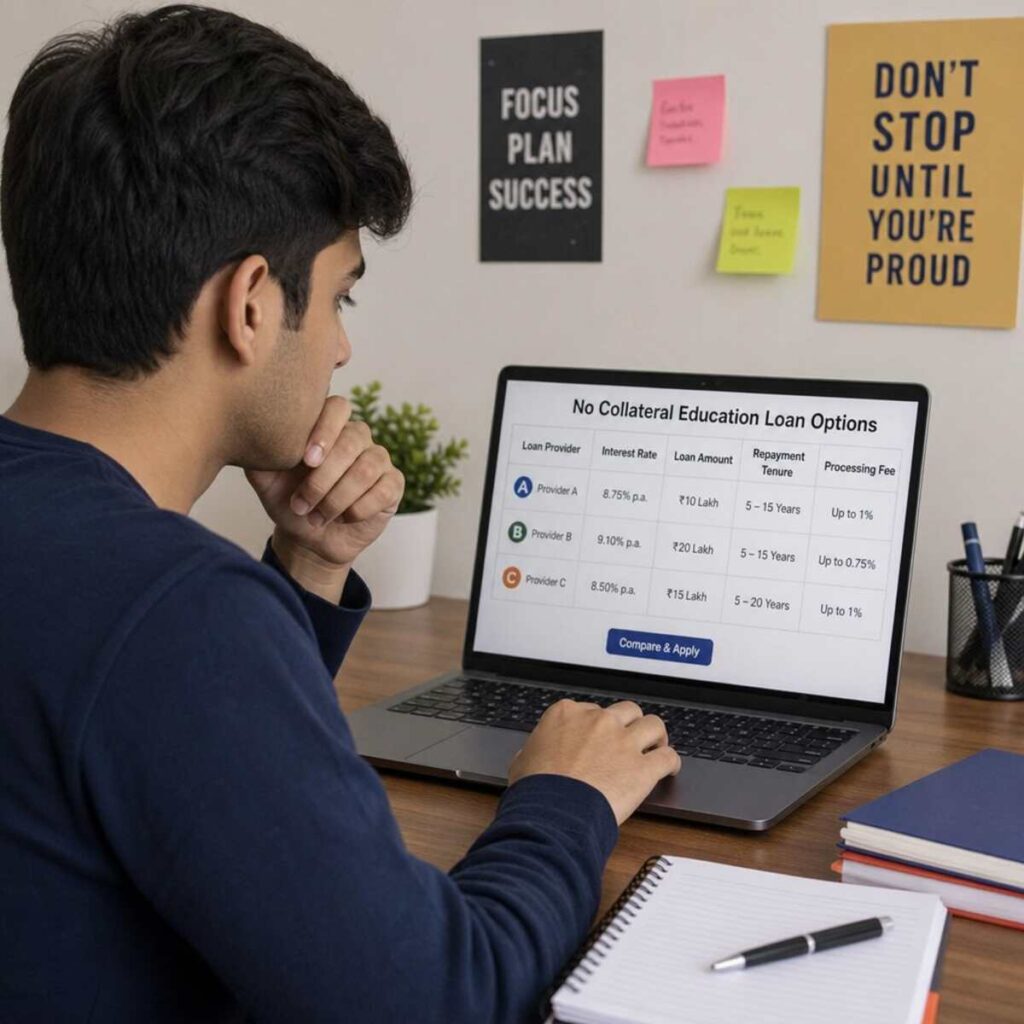
Start With the Smarter Path to Student Funding
If you need money for college, graduate school, career training, or a professional program, you may not want to pledge a car, savings account, home equity, or other family asset just to keep your education moving. The good news: many student-focused borrowing paths are designed around school enrollment, cost of attendance, credit profile, and future repayment ability—not traditional collateral.
This page helps you evaluate an education loan without collateral, understand when a co-applicant or co-signer may still be requested, and compare the most common loan options for students in the United States. The goal is simple: borrow only what you need, choose the lowest-risk option available, and know the repayment rules before you sign.
Important note: This content is educational only and is not financial, legal, or tax advice. Loan approval, APR, fees, repayment options, borrower protections, and eligibility vary by lender, school, loan type, credit profile, and law. Always review official federal guidance and lender disclosures before applying.
Ready to move forward? Use the checklist below to prepare your documents, compare federal and private options, and request only the amount you truly need.
What “No Collateral” Really Means for Student Loans
A collateralized loan is backed by property the lender can claim if the borrower defaults. In contrast, many student loans are unsecured, meaning you are not pledging a specific asset such as a vehicle or home. The Consumer Financial Protection Bureau describes a loan for college tuition as an example of an unsecured loan that does not require collateral. (files.consumerfinance.gov)
That does not mean the loan is risk-free. With unsecured student debt, the lender may still evaluate your credit, income, enrollment, program, school, degree level, and repayment capacity. If you miss payments, you can still face late fees, credit damage, collections, default consequences, and legal action, depending on the loan type and terms.
Here is the key distinction:
- No collateral means you are not pledging an asset to secure the loan.
- No co-applicant or no co-signer means another person is not legally sharing repayment responsibility.
- No credit check is different again. Most federal student loans do not require a credit check, except Direct PLUS Loans, while private loans often require an established credit record. (studentaid.gov)
For many borrowers, the best first step is not a private lender at all. It is the FAFSA, because federal aid may include grants, work-study, and federal student loans, and submitting the FAFSA is free. (studentaid.gov)
Who This Student Loan Path Is Built For
This guidance is a strong fit if you are:
- A U.S. student or eligible borrower looking for no collateral loans for education-related costs.
- An undergraduate who wants to avoid asking a parent or relative to co-sign.
- A graduate or professional student comparing federal Direct Unsubsidized, Grad PLUS, and private options.
- A student with limited credit history who needs to understand what approval factors matter.
- A borrower who has already reviewed scholarships, grants, savings, employer tuition support, payment plans, and federal aid.
- A family trying to avoid using a home equity loan, personal loan, credit card, or retirement funds for education costs.
It may not be the right fit if you are trying to borrow more than your school-certified costs, avoid repayment entirely, hide debt from a required contributor, or apply without reviewing the legal terms. Student loans are contracts. The easy part is applying; the wise part is understanding repayment before the first disbursement.
The Core Benefits of a Collateral-Free Education Financing Strategy
A well-planned education loan strategy can help you:
- Protect family assets. You can look for school-based funding without pledging a home, vehicle, or deposit account.
- Start with federal protections. Federal student loans generally offer fixed rates, no co-signer requirement for student loans, and more flexible repayment protections than private loans. (studentaid.gov)
- Compare private loans carefully. Private lenders may offer fixed or variable rates, different repayment choices, and potentially larger borrowing amounts, but terms depend heavily on credit and lender policies. (consumerfinance.gov)
- Avoid overborrowing. A disciplined plan focuses on the gap after scholarships, grants, savings, work-study, and federal aid.
- Understand total cost. APR, repayment term, interest accrual, fees, deferment rules, and capitalization can matter more than the advertised monthly payment.
Conversion tip: Before you apply anywhere, build a one-page borrowing plan: total school cost, free aid, federal loan eligibility, remaining gap, expected income after graduation, and maximum monthly payment you can realistically handle.
Federal First: The Smartest Starting Point for Most Borrowers
For most U.S. students, the first step is completing the FAFSA. Federal Student Aid explains that submitting the FAFSA can provide access to federal grants, work-study, and federal student loans, and that states, schools, and some private aid providers also use FAFSA information to determine aid eligibility. (studentaid.gov)
Federal student loans are often the first borrowing option to evaluate because:
- Most federal student loans for students do not require collateral.
- You generally do not need a co-signer for federal student loans.
- Federal loans have fixed interest rates for new loans.
- Federal repayment options may include plans tied to income, deferment, forbearance, and potential forgiveness paths, depending on loan type and eligibility.
- You can compare federal repayment plans with the official Loan Simulator, which estimates monthly payments, total paid over time, and eligibility for certain plans. (studentaid.gov)
Federal Student Aid also notes that being a FAFSA contributor does not make a family member responsible for paying your education costs, and completing the FAFSA does not legally require you or your contributors to accept federal loans. (studentaid.gov)
That last point matters. Some students avoid the FAFSA because they think parent information equals parent responsibility. It does not. Contributor information helps determine aid eligibility; it is not the same as co-signing a loan.
Federal vs. Private Student Loans: A Practical Comparison
Federal student loans may be better if you want:
- No co-signer for most student Direct Loans.
- A fixed interest rate.
- Access to federal repayment plans.
- More options if your income drops after school.
- Potential forgiveness, cancellation, or discharge programs if you meet specific requirements.
- A borrowing path that begins with the FAFSA rather than private underwriting.
The CFPB recommends researching federal Direct Loans before shopping for private loans and notes that federal loans generally provide more repayment flexibility if borrowers struggle. (consumerfinance.gov)
Private student loans may be considered if:
- You still have a funding gap after scholarships, grants, savings, work income, school aid, and federal loans.
- You have strong credit, income, or a qualified co-signer who may help you access better terms.
- You are a graduate or professional student comparing private offers against federal PLUS costs.
- You fully understand that private loan repayment options depend on the lender and loan agreement. (consumerfinance.gov)
The Writing Guru rule:
Choose the loan that gives you the lowest responsible total cost, not merely the fastest approval or the largest amount. A loan that is easy today but inflexible tomorrow can become expensive in the chapter after graduation.
Can You Get a Student Loan Without a Co-Applicant?
Yes, it may be possible, but the answer depends on the loan type.
For federal student loans, you generally do not need a co-signer, and most federal student loans do not require a credit check, except for Direct PLUS Loans. (studentaid.gov)
For private student loans, a co-signer may be required, especially if the student has limited credit history, little income, or a high requested loan amount. The CFPB explains that private student loan borrowers may be required to have a co-signer, and that co-signers are legally obligated to repay the loan along with the primary borrower. (consumerfinance.gov)
A co-applicant can sometimes help with approval odds or rate offers, but that benefit comes with risk. Missed payments can affect both the student and the co-signer’s credit, and private lenders may pursue collection from the co-signer if the borrower defaults. (consumerfinance.gov)
If your goal is no co-applicant, strengthen the parts of your application you control:
- Apply for federal aid first.
- Choose an eligible school and program with a clear cost of attendance.
- Borrow only the remaining gap.
- Build credit responsibly before applying.
- Maintain income if possible.
- Reduce existing debt.
- Compare lenders that consider student-only applications.
- Review whether a lender offers co-signer release if you do apply with one.
Eligibility: What Lenders and Programs Usually Review
Eligibility rules vary, but most student financing paths look at a blend of academic, identity, financial, and credit factors.
For federal student aid, expect review of:
- Your FAFSA submission.
- Citizenship or eligible noncitizen status.
- Your dependency status.
- Your school list and program plans.
- Required contributor information, when applicable.
- Federal tax information consent and transfer.
- Enrollment and school certification.
- Loan type and annual or aggregate loan limits.
Federal Student Aid says dependent students generally must provide parent information on the FAFSA, but a parent contributor is not automatically responsible for paying education costs. If a dependent student indicates that parents refuse to provide information, the student may be limited to a Direct Unsubsidized Loan only and may lose eligibility for a Pell Grant and most other federal aid. (studentaid.gov)
For private student loans, lenders may review:
- Credit score and credit history.
- Income or employment.
- Debt-to-income ratio.
- School and program type.
- Enrollment level.
- Requested loan amount.
- Expected graduation date.
- Citizenship or residency status.
- Whether a co-signer is included.
- Repayment option selected.
Private lenders often require an established credit record and may require a co-signer. (studentaid.gov)
Required Documents: Build Your Application File Before You Apply
A prepared borrower looks stronger and moves faster. Gather documents before you submit applications so you can respond quickly to school or lender requests.
FAFSA and federal aid documents
Federal Student Aid’s FAFSA checklist includes items such as a StudentAid.gov account, contributor information, federal tax information, records of child support received, records of assets, and a list of schools you are interested in attending. (studentaid.gov)
You may need:
- Your StudentAid.gov account credentials.
- Your Social Security number, unless an exception applies.
- Contributor names, emails, and identifying information, if required.
- Consent for federal tax information transfer.
- Tax return details or access to requested tax records.
- Current balances for cash, checking, and savings accounts.
- Investment and asset records, when required.
- Child support received, when applicable.
- A list of colleges, career schools, or trade schools.
- Documentation of special financial circumstances, if you plan to request a professional judgment from your school.
Private student loan documents
Private lenders set their own requirements, but you may be asked for:
- Government-issued ID.
- Social Security number or taxpayer identification details, if applicable.
- Date of birth and permanent address.
- School name and program information.
- Enrollment status.
- Expected graduation date.
- Requested loan amount.
- Income documents, such as pay stubs or tax forms.
- Employment information.
- Monthly housing payment.
- Existing debt information.
- Bank account details for autopay, if you choose it.
- Co-signer information, if you include one.
- Immigration or residency documents, if applicable.
Do not submit false or inflated information. A student loan application is a legal and financial document, not a wish list.
APR, Interest Rates, and Total Cost: What Really Determines Your Price
The interest rate is the price you pay to borrow money. APR is a broader cost measure that may include certain fees and finance charges. When comparing loan options for students, do not stop at the monthly payment. A longer repayment term can make a payment look affordable while increasing the total interest paid.
Federal loan rate factors
Federal student loan rates are fixed for the life of the loan and vary based on loan type and the date the loan is first disbursed. Federal Student Aid servicer information lists rates for Direct Loans first disbursed from July 1, 2026 through June 30, 2027, including 6.52% for undergraduate Direct Subsidized and Unsubsidized Loans, 8.07% for graduate or professional Direct Unsubsidized Loans, and 9.07% for Parent PLUS and Grad PLUS Loans. (edfinancial.studentaid.gov)
Because federal rates can change for new loans each academic year, always verify the rate and fee for your specific loan before accepting it.
Private loan APR factors
Private student loan APRs are usually risk-based. A lender may consider:
- Credit score.
- Credit history length.
- Payment history.
- Income.
- Debt-to-income ratio.
- Loan amount.
- School and program.
- Degree level.
- Repayment term.
- In-school payment option.
- Fixed versus variable rate selection.
- Co-signer strength, if included.
- Autopay discount, if offered.
- Market interest rate environment.
Private loans may have fixed or variable rates, and variable rates can cause monthly payments to change. Federal guidance notes that private student loans may have variable or fixed rates that can be higher or lower than federal rates depending on the borrower’s circumstances. (studentaid.gov)
The cost question that matters most
Ask this before signing: “What is the total amount I am expected to repay if I make only scheduled payments?”
Then ask:
- Does interest accrue while I am in school?
- Is there an origination fee?
- Is there a late fee?
- Is the rate fixed or variable?
- When does repayment begin?
- Can I make interest-only payments while enrolled?
- Is there a prepayment penalty?
- What happens if I return to school, lose income, or enter military service?
- What deferment or forbearance options are available?
- Are there co-signer release options?
Repayment Options: Choose Before You Borrow
Repayment should not be an afterthought. It is the product you are actually buying.
Common federal repayment paths
Federal repayment options may include standard, graduated, extended, and income-driven options, depending on your loan type and eligibility. Federal Student Aid’s Loan Simulator can help compare estimated monthly payments, repayment periods, total paid, and potential forgiveness under different plans. (studentaid.gov)
Income-driven plans use income and family size to determine monthly payments, and official repayment rules can change. Federal Student Aid notes that the Department of Education has been implementing significant changes to federal student aid programs, so borrowers should check official updates before selecting a repayment plan. (studentaid.gov)
Common private repayment structures
Private student loan repayment options depend on the lender and your loan agreement. The CFPB emphasizes that private loan options vary by lender and agreement, especially if borrowers are struggling or trying to resolve default. (consumerfinance.gov)
A private lender may offer:
- Immediate principal and interest repayment.
- Interest-only payments while in school.
- Small fixed in-school payments.
- Deferred repayment until after graduation or leaving school.
- Shorter terms with higher monthly payments and lower total interest.
- Longer terms with lower monthly payments and higher total interest.
If you choose deferred repayment, understand that interest may accrue while you are in school. If unpaid interest is later added to the principal, the loan can become more expensive.
Product-Style Checklist: What to Look for in a No-Collateral Student Loan Offer
When comparing offers, look beyond the headline rate.
A strong student loan offer should make these details clear:
- Whether collateral is required.
- Whether a co-signer or co-applicant is required.
- Whether the rate is fixed or variable.
- The APR range and your approved APR.
- Origination, late, returned-payment, or other fees.
- Total repayment amount.
- In-school repayment choices.
- Grace period, if any.
- Deferment and forbearance policies.
- Co-signer release rules, if relevant.
- Autopay discount terms, if offered.
- School certification process.
- Cancellation policy if you do not enroll.
- Servicer contact information.
- How and when funds are disbursed.
If a lender cannot explain the cost clearly, pause. Confusion is not a feature; it is a warning light.
A Step-by-Step Path to Apply With Confidence
Step 1: Estimate the real cost
Add tuition, required fees, books, supplies, equipment, housing, food, transportation, health insurance, and personal expenses. Then subtract scholarships, grants, savings, work income, employer support, family contribution, and school payment plans.
Your loan target should be the gap—not the maximum amount anyone will approve.
Step 2: Submit the FAFSA
Complete the FAFSA even if you are unsure whether you will qualify for need-based aid. Federal Student Aid explains that the FAFSA is free and is used for federal aid as well as aid from states, schools, and some private providers. (studentaid.gov)
Step 3: Review your school’s aid offer
Look carefully at grants, scholarships, work-study, subsidized loans, unsubsidized loans, PLUS options, and remaining balance. Accept free aid first. Consider subsidized federal loans before unsubsidized loans if offered.
Step 4: Compare federal borrowing before private borrowing
Federal loans are often the safer first borrowing layer because they usually do not require a co-signer, have fixed rates, and offer more repayment flexibility. (studentaid.gov)
Step 5: If a gap remains, shop private lenders
Compare multiple private lenders if you still need funding. Review APR, fixed versus variable rate, repayment term, co-signer rules, in-school payment choices, fees, hardship options, and total repayment cost.
Step 6: Decide whether a co-applicant is worth it
A co-signer may improve approval odds or rate offers, but the co-signer becomes legally responsible for the debt. The CFPB notes that late or missed payments on a co-signed loan can affect both the borrower and co-signer’s credit. (consumerfinance.gov)
Step 7: Borrow less than you are offered
Approval is not a recommendation. If you are approved for more than you need, reduce the amount. Future you will thank present you.
Step 8: Read the disclosure and promissory note
Before signing, confirm the APR, fees, repayment start date, deferment rules, default terms, and cancellation rights. Keep copies of every document.
Step 9: Build a repayment plan now
Estimate your post-school income, taxes, rent, transportation, insurance, and loan payments. If the payment only works in a best-case scenario, the loan may be too large.
Risks to Understand Before You Sign
An education loan without collateral can still carry serious consequences.
Credit damage
Late or missed payments can be reported to credit bureaus. For private student loans, default can harm your credit and lenders may take collection action. (consumerfinance.gov)
Co-signer exposure
If a co-signer is on the loan, missed payments can harm their credit too, and they are legally responsible for repayment. (consumerfinance.gov)
Variable rate risk
A variable rate may start lower but can rise. If the rate rises, your payment and total cost may increase.
Limited private-loan flexibility
Private student loan hardship options depend on the lender and loan contract. You may not receive the same repayment protections available through federal student loans. (consumerfinance.gov)
Overborrowing
Borrowing for lifestyle costs, nonessential expenses, or a school with poor completion outcomes can create repayment stress.
Opportunity cost
Student debt can affect future choices, including housing, graduate school, career flexibility, savings, and family finances.
Guru guidance: The right loan opens a door. The wrong loan locks one behind you.

How to Improve Approval Odds Without Collateral
You cannot control every underwriting factor, but you can control your preparation.
Try this:
- Complete the FAFSA early.
- Apply only for the amount you need.
- Choose an accredited or otherwise lender-eligible school.
- Maintain satisfactory academic progress.
- Build credit with on-time payments.
- Keep credit card balances low.
- Avoid opening multiple new credit accounts right before applying.
- Show income if you have it.
- Reduce other debts where possible.
- Compare student-only private lenders if avoiding a co-signer is a priority.
- Consider a less expensive school, community college transfer path, assistantship, employer benefit, or part-time enrollment if borrowing becomes too large.
Remember: the strongest loan application is not the one that asks for the most money. It is the one that proves the amount is reasonable.
Pricing and Terms: What You Should Expect to Review
Because terms vary, no responsible product page should promise one APR, one payment, or one approval rule for every borrower. Instead, expect pricing to be personalized.
Review these cost elements:
- Principal: the amount borrowed.
- Interest rate: the percentage charged on the unpaid balance.
- APR: a broader cost measure that may include certain fees.
- Origination fee: a fee deducted from or added to loan funds, if applicable.
- Repayment term: how long you have to repay.
- Monthly payment: what you owe on the selected plan.
- Total repayment amount: principal plus interest and applicable fees over time.
- Autopay discount: a possible rate reduction if you enroll in automatic payments.
- Late or returned-payment fees: charges triggered by missed or failed payments.
For federal loans, verify the rate and fee for your loan type and disbursement date. For private loans, compare the final approved disclosure—not only the advertised range.
Clear Calls-to-Action
Check your no-collateral student funding path
Start with your school cost, FAFSA status, and remaining gap. Then compare federal and private options side by side.
CTA: Review your student loan options before you apply.
Build your document checklist
Gather your FAFSA information, tax details, school information, identity documents, and income records before submitting applications.
CTA: Prepare your application file today.
Compare total repayment, not just approval
A fast approval can still be expensive. Choose the option that gives you the best blend of cost, flexibility, and borrower protection.
CTA: Compare APR, term, repayment plan, and total cost now.
FAQs
Can I get an education loan without collateral in the U.S.?
Yes, many student loan options do not require traditional collateral. Federal student loans for students generally do not require collateral or a co-signer. Private student loans are also commonly unsecured, but lenders may review credit and may require a co-signer depending on your profile. (studentaid.gov)
Is “no collateral” the same as “no co-signer”?
No. No collateral means you are not pledging an asset. No co-signer means another person is not legally responsible for repayment. A loan can be unsecured but still require a co-signer.
What is the easiest student loan to get without a co-applicant?
For many students, federal Direct Loans are the first option to review because they generally do not require a co-signer and most do not require a credit check, except PLUS Loans. You must complete the FAFSA and meet eligibility requirements. (studentaid.gov)
Do private student loans require a co-signer?
They may. Private lenders often require an established credit record, and students with limited income or credit history may be asked to add a co-signer. The CFPB notes that a co-signer is legally obligated to repay the loan along with the borrower. (consumerfinance.gov)
Can I apply if my parents will not help with the FAFSA?
Possibly, but proceed carefully. Federal Student Aid says that if a dependent student completes the FAFSA without parent information because parents refuse to participate, the student may be eligible only for a Direct Unsubsidized Loan and not for a Pell Grant or most other federal aid. (studentaid.gov)
Will applying for FAFSA make my parents responsible for my loans?
No. Federal Student Aid states that being identified as a FAFSA contributor does not make a family member responsible for paying your education costs. (studentaid.gov)
Are federal loans always cheaper than private loans?
Not always for every borrower, but federal loans are often recommended first because they have fixed rates and more borrower protections. Private rates can be higher or lower depending on credit, income, co-signer strength, and market conditions. (studentaid.gov)
What documents do I need for a no collateral student loan?
For federal aid, expect FAFSA-related information such as your StudentAid.gov account, contributor details, tax information consent, asset records, child support received if applicable, and school list. For private loans, expect identity, school, enrollment, income, credit, and possibly co-signer information. (studentaid.gov)
Can I use a no collateral education loan for living expenses?
Student loans are typically intended for education-related costs included in your school’s cost of attendance, such as tuition, fees, books, supplies, housing, food, and transportation. The exact eligible expenses and disbursement process depend on the loan type, lender, and school certification.
What happens if I cannot repay a private student loan?
Contact your lender or servicer immediately. The CFPB states that private loan options depend on the lender and agreement, and default can harm your credit and lead to collection activity. (consumerfinance.gov)
Should I choose fixed or variable interest?
A fixed rate gives predictable payments. A variable rate may start lower but can change over time, which can increase your payment and total cost. If your budget has little room for surprises, predictability may be more valuable than a low introductory rate.
How much should I borrow?
Borrow the smallest amount needed after free aid, savings, work income, school payment plans, and federal loan options. Do not borrow the maximum just because it is offered.
Can I refinance later?
Possibly, but refinancing federal loans into a private loan can cause you to lose federal benefits and protections. Review the tradeoffs carefully before refinancing.
Final Borrower Checklist
Before you accept any loan, confirm:
- I completed the FAFSA or understand why I am not eligible.
- I accepted scholarships and grants first.
- I compared subsidized and unsubsidized federal options.
- I understand whether the loan requires collateral.
- I understand whether the loan requires a co-signer.
- I know the APR, interest rate type, fees, and repayment term.
- I know when payments begin.
- I know the total estimated repayment amount.
- I understand deferment, forbearance, and hardship options.
- I have read the promissory note and disclosures.
- I borrowed only what I need.
A Smarter Way to Move Forward
An education can be a powerful investment, but the loan should serve the goal—not swallow it. Start with federal aid, compare every private offer carefully, protect your future cash flow, and avoid pledging assets or adding a co-applicant unless the benefit clearly outweighs the risk.
If you are searching for no collateral loans, focus on clarity: eligibility, APR, repayment flexibility, total cost, and legal responsibility. The best borrowing decision is not the one that gets you money fastest. It is the one you can live with confidently after graduation.
CTA: Compare your education loan without collateral options, prepare your documents, and choose the lowest-risk path before you sign.
Compliance-friendly disclaimer: This page is for general educational purposes only and is not financial, legal, tax, or credit advice. Loan terms, APRs, fees, eligibility, repayment plans, and borrower protections vary and may change. Review official federal resources, school financial aid guidance, and lender disclosures before applying or accepting any loan.